
Inside the Yellowstone Park gate, the road continued along the Madison River, through lush green forests and past tremendous mountains of stone, but a change had occurred. This was sacred land, protected and cherished for what it is, no homes, ranches or businesses altered the landscape. Within 20 minutes of the park entry, I was welcomed to this Shangri La by a moose crossing the road two cars in front of me to join 5 other moose grazing in a slow spot in the river. There were no antlered males in the group, but I got a very close up view when a moose cow, as tall I am, chose to munch on the grass next to my van. Moose warning signs on roads in Maine, Minnesota, Wisconsin, New Hampshire, New York, Western Massachusetts, Glacier Park and Southern Canada kept me scanning the landscape on this journey without success, and now, I find myself in the midst of them as I enter Yellowstone Park. Plumes of steam rising high in the clear air drew me to my next stop, the Lower Geyser Basin, where, climbing out of my van, I spotted a single Bison standing 30 yards from the parking lot. It was as if this was a plant, a tame “Greeting Bison” representing the majesty of this park. Visitors are required to maintain a distance of 25 yards from the wildlife (100 yards from bears and wolves), but even at 25 yards, or what I thought was 25 yards, I felt too close. There is no telling what this wild and powerful beast, with a deceptively sweet face (much like the mocking smile on an alligator’s face), might be thinking, and there have been plenty of Bison gorings to bear this out.


Walking the boardwalk through the Lower Geyser Basin, I discovered that the earth, too, has a certain dangerous beauty in Yellowstone. Luminous boiling pools, bubbling mudpots, and fitful geysers link the surface of the earth to its seething core. The mercurial ground is raw and alive here. Signage warns tourists to stay on the boardwalks with pictographs showing that what looks like solid ground is but a thin crust which, if stepped on, could break through, dropping the foolish usurper into the boiling stew below the surface. I wasn’t about to test this, but I did wonder about the bison hoof tracks and dung visible on the fragile ground around the geysers and pools. I asked a ranger about this and she told me that the heavy bison intuitively know where to step, but that bison have broken through the surface, and were swallowed by the unforgiving hole, where the animal cooked until the body decomposed. The boardwalks seemed dangerously close to these angry geysers, but what a thrill to have the opportunity to get up close to the active fountains and pools. One geyser field I visited displayed signs with photos showing the forested hillside that stood on the site before, just 30 years ago, an earthquake ripped the surface open to reveal its smoldering underbelly. Yellowstone is a living volcano, and even with its clever system of vents and geysers to release pressure, the surface is in flux, subject to earthquake swarms and the explosive thermal force that festers just below the surface. After living in Hawaii with its active volcanoes, and California, with its dynamic faults and earthquakes, I fear and respect the unpredictable forces deep within the earth.
The drive to my campsite on Yellowstone Lake yielded yet another wildlife sighting, a bull elk with a magnificent rack many times larger than his head, that stopped traffic where he laid, holding his antlered head high, at the edge of the forest next to the road. This sighting led me to the discovery of another danger in the park, motorists who forget the rules of the road when wildlife presents itself.

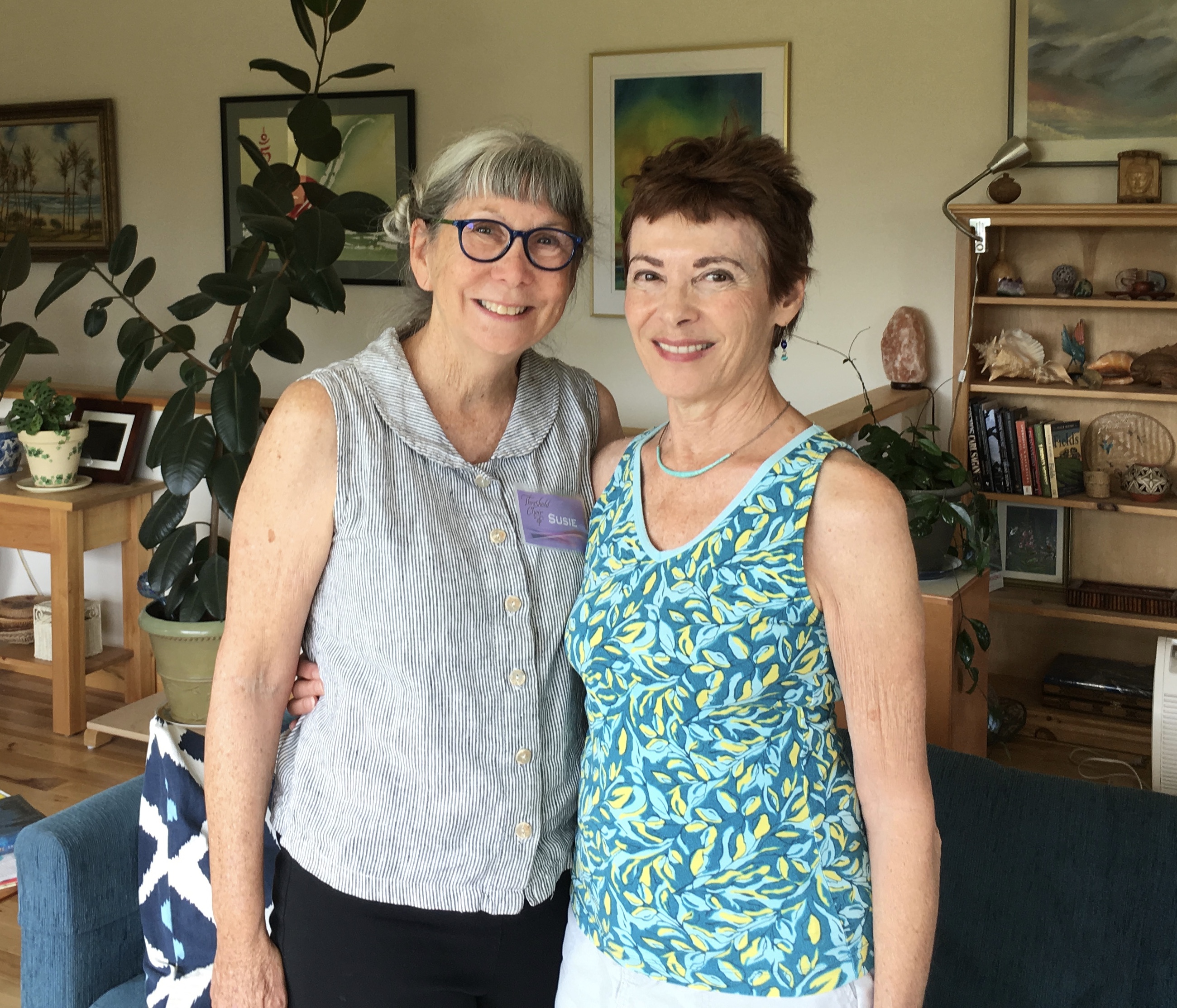
At nearly 7,000 feet in elevation, my campsite in the trees next to Yellowstone Lake promised exceptional star gazing. No moon was visible during my stay in Yellowstone, and a deep black velvet sky served as a perfect backdrop for viewing the starshow. Dark nights are like dark chocolate to me. I crave them. My passion for the dark grew from beach bonfires in Pacific Grove and Carmel. During the 13 years that I lived on Monterey Bay, I often gathered friends for nights singing and reading poetry around a fire on the beach. We sometimes held Threshold Choir practices on the beach, as well. There were no city lights to taint the magic of the night sky and the ocean in view of the beaches where fires were permitted. How those nights fed me! My beloved Threshold Choir sisters, Jill and Suzan, were always by my side in the cold, the wind and the fog, for Solstice celebrations, birthday parties, Threshold Choir practices, and when I retired and was ready to leave Pacific Grove, they were there, with my family and other dear friends, for my going away bonfire party.
With the majority of my travel nights spent sleeping in parking lots, rest stops and driveways, blocking the glare of passing cars, overhead lighting and street lights forces me to use the insulated black-out panels I made to cover the van windows to create a dark night where there is none. Sadly, campground bathrooms with all night lighting often force me to cover windows, too, and Yellowstone was no exception. Settling in after a starlight walk to the lake on that first night, I discovered that bathroom lighting fouled my night vision from my bed. The next night, I pulled forward into the back-in campsite, a feat that required careful maneuvering and multiple turns back and forth to achieve, in this tight camping space embraced by magnificent trees. With the opportunity to view the unpolluted mountain sky, I was willing to do whatever it took. With the windshield covered, I was able to block the bathroom lights, open curtains, and invite the magic of night into my bedchamber. I slept little in Yellowstone, preferring shooting stars and the dreamy milky way to sleep. How very different our nights have become from the nights of our ancestors, most of us must leave home to experience the glories of the night sky.

The Crowds Wait 
Old Faitful Geyser Goes Off On Schedule

Boiling pots in Yellowstone Lake 
Boiling Pool on the shore of Yellowstone Lake

Compelled not to miss any of the marvels Yellowstone has to offer, I spent the next few days driving to every corner of the park. I walked the geyser fields, joined the crowds “ooing” and “aweing” at Old Faithfull’s grand fountain, lost myself gazing into the effervescent Caribbean blue of the boiling pools that decorate the landscape, saw steaming fissures emerging from rivers and from the banks of Yellowstone Lake, experienced the earthy colors of the bacteria that streaks the earth in the geyser run-off, delighted I the park’s wild rivers, waterfalls, and forests, drove a stretch of the Continental Divide and was mesmerized by infinite craggy mountain views the reach to the horizon. As if the geology were not enough, the abundance of wildlife in the park is startling. Yellowstone, our first National Park, makes you proud to be an American, proud that this country protected this unique landscape for the people, and its animal inhabitants, and worked to reestablish wildlife that was threatened do to loss of habitat and over hunting. The young German couple camping next to me said that that there are no national parks in their country. Having the opportunity to witness wild and free bison and moose, a rutting elk bugling for a mate, bald eagles and beaver dams is something I won’t soon forget. In the park, there is a slogan, “Yellowstone Forever”, insuring the perpetuity of the park will require vigilance to insure that political interests and greed do not compromise our public lands.












 Susie's Travels - Wonder, Connection, Singing in Community